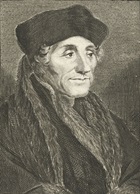
About Desiderius Erasmus
Erasmus (1469-1536) was a scholar during the Renaissance. He wanted to produce a Latin version of the Bible which was superior to the existing version created by Jerome, 11 centuries prior. The first edition of this work was printed in 1516, titled "Novum Instrumentum omne". It consisted of a critical version of the Latin text based on collating dozens of Latin manuscripts, and a parallel Greek version (based on a collation of eight Greek manuscripts). The purpose of the Greek was to confirm the accuracy of the Latin translation. The purpose of the whole was to replace the older Vulgate translation. The first edition contained many errors and so a second version was printed in 1519 under the title "Novum Testamentum Omne". This version was used by Martin Luther to create his German translation of the New Testament. Erasmus published a third edition in 1522, which was used to create the early English translations from the Tyndale (1526) to the King James Version (1611). A fourth version was printed in 1527, and a final (fifth) version was printed in 1535. With the Reformation, people became more interested in the Greek text than the Latin. The Greek text became known as the Textus Receptus ("received text").
The purpose of the Textus Receptus was to create a single text that included all of the canonical New Testament books, since the older Greek texts were only partial. Further, differences between the older manuscripts were resolved such that the end result was the most reliable text of the original autographs (now lost). This area of effort is known as Lower Textual Criticism and is concerned with getting as close to the original autographs as possible.
Having said that, we feel it is important that people understand that the differences in the old Greek manuscripts do not represent a problem in the sense that there are different doctrines in different manuscripts. Rather, it is a combination of the following factors. First, most old manuscripts are not entire. Pieces of books or verses may be missing. Thus, reconstruction involves combining different manuscripts such that we have the whole. Second, there are alternate spellings of some proper names. These aren't errors since many names have multiple "correct" spellings. The purpose of textual criticism in these cases is simply trying to get back to the original spelling that was used. Third, since many place names change throughout history, some manuscripts were updated to contain the, then current, place names. This doesn't represent a problem either - all modern translations use modern names for most place names. It was simply a way to make the text more understandable to the people of the time. Textual criticism here is interested in getting back to the original names. Fourth, there were occasional copying errors, such as doubling a line of text, or leaving out a line of text. Though rare, these errors are extremely obvious and easily corrected. Finally, once these differences are excluded, there remain few differences between manuscripts - and none of them carry any theological significance. The old Greek manuscripts are remarkably consistent in this regard. In fact, the sheer number of manuscripts now known to us (far more than Erasmus had available in his day), and the consistency across them, is proof that the reconstructed Greek manuscripts we use today are certainly unchanged, in any way that matters, from the original autographs. No copies of secular ancient works demonstrate this level of fidelity. This represents both the care taken by copyists of the scripture and the gracious providence of God over the centuries.